
SDG 2.0 and 'Bastar Anjor' will give new momentum to the vision of a developed Chhattisgarh: Chief Minister Shri Vishnu Deo Sai
Effective monitoring of development works will be done through 343 indicators at the state level and 99 at the district level. Chief Minister Shri Vishnu Deo Sai today released the Chhattisgarh SDG 2.0 framework prepared by the State Planning Commission in the presence of members of the Council of Ministers at Mantralaya Mahanadi Bhawan.
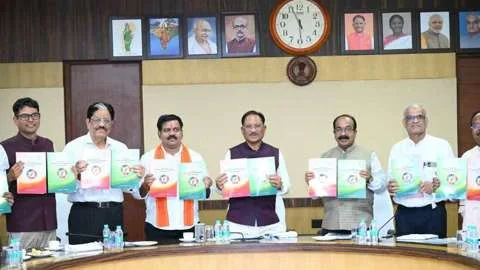
Effective monitoring of development works will be done through 343 indicators at the state level and 99 at the district level. Chief Minister Shri Vishnu Deo Sai released the Chhattisgarh SDG 2.0 framework prepared by the State Planning Commission today at Mantralaya Mahanadi Bhawan in the presence of members of the Council of Ministers. On this occasion, the Chhattisgarh SDG State and District Indicator Framework 2.0 and Metadata Handbook were also released. Additionally, 'Bastar Anjor', an innovative initiative prepared for inclusive, convergence-based, and measurable development of the Bastar division, was launched. Chief Minister Shri Vishnu Deo Sai said that effective implementation of schemes, precise data, and outcome-based monitoring are essential for building a developed Chhattisgarh. The SDG 2.0 framework will provide a strong foundation for evidence-based policy-making, better inter-departmental coordination, and regular monitoring of schemes for the government. He said this initiative is a significant step towards achieving the goal of 'Viksit Chhattisgarh @2047'. The Chief Minister stated that the state government's objective is not just to operate development schemes, but to ensure their actual impact reaches the last person. Through SDG 2.0, development progress will be made more transparent, measurable, and accountable. Under the new SDG 2.0 framework, the number of indicators at the state level has been increased from 275 to 343, and at the district level from 82 to 99. This will enable more comprehensive, precise, and scientific monitoring of development works. The Metadata Handbook standardizes the calculation methodology and reporting system for each indicator, ensuring data quality and reliability across the state. On this occasion, Vice Chairman of the State Planning Commission, Shri Ganesh Shankar Mishra, while presenting the concept of 'Bastar Anjor', explained that it is a convergence-based development model designed to realize the resolution of making Bastar division the most developed tribal region of the country. He mentioned that under the 3+4 model of 'Bastar Anjor', three major district-level initiatives—Niyad Nellanar 2.0, Bastar Munne, and Swasth Bastar—are converged with four major national and state-level development frameworks: SDG 2030, Viksit Chhattisgarh @2047, and the Aspirational District and Block programs. Its objective is to achieve tangible and measurable results in areas like education, health, livelihood, and infrastructure through better coordination without additional resources. 'Bastar Anjor' is a visionary initiative based on the spirit of 'Antyodaya se Sarvodaya', which will play a significant role in making Bastar a national model for inclusive, sustainable, and outcome-oriented development. Deputy Chief Minister Shri Arun Sao, Deputy Chief Minister Shri Vijay Sharma, members of the Council of Ministers, Chief Secretary Shri Vikas Sheel, Principal Secretary to the Chief Minister Shri Subodh Kumar Singh, and senior administrative officers were present at the event.
त्रुटि दिखी? हमारी सुधार नीति और संपादकीय नीति देखें।