Chief Minister Shri Vishnu Deo Sai presented Chhattisgarh's public-participation-based water conservation model on the national platform in the presence of Prime Minister Shri Narendra Modi
Chhattisgarh has presented an effective model of public participation before the country to conserve every drop of rain and direct it into the earth, securing water for future generations.
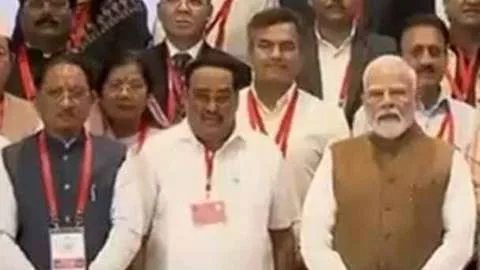
Chhattisgarh has presented an effective model of public participation before the country to conserve every drop of rain and direct it into the earth, securing water for future generations. In the third phase of the Ministry of Jal Shakti's 'Jal Sanchay Jan Bhagidari' campaign, Chhattisgarh has secured the first position in the country. Five districts of the state have also successfully secured positions among the top 10 districts in the country in the field of water conservation. In the departmental summit of the Ministry of Jal Shakti organized at Sushma Swaraj Bhawan in New Delhi in the graceful presence of Prime Minister Shri Narendra Modi, Chief Minister Shri Vishnu Deo Sai shared the innovations and public-participation-based efforts being made for water conservation in Chhattisgarh on the national platform. During the 'Catch the Rain' session of the conference, Deputy Chief Minister Shri Arun Sao gave detailed information about the work being done in the state for rainwater harvesting, groundwater recharge, and conservation of drinking water sources. Union Minister of Jal Shakti Shri C. R. Patil, water resource ministers of various states, and senior officials were present at the conference. Made water conservation a public campaign, not a government program: Chief Minister Shri Sai. Chief Minister Shri Vishnu Deo Sai said that Chhattisgarh has not limited water conservation only to government schemes and the construction of water structures. By involving farmers, village panchayat members, Jal Sakhis, Jal Mitras, and local communities, it has been given the form of a broad public campaign. Chief Minister Shri Sai said that he himself comes from a farmer family and has farmed by ploughing fields in his native village Bagia. Therefore, he has very closely seen and understood the importance of water in farming and rural life. For a farmer, water is not just a natural resource, but a subject connected to his crop, family, livelihood, and future. This is the reason why farmers and villages have been kept at the center of water conservation schemes in Chhattisgarh. He said that Chhattisgarh, which has a share of about four percent in the total geographical area of the country, is continuously performing excellently in the 'Jal Sanchay Jan Bhagidari' campaign. This achievement is not only of the number of water structures, but also of the collective consciousness and public participation developing in the state towards water conservation. The '5 Percent Model' emerged from Korea, farmers are voluntarily giving land. Chief Minister Shri Sai made special mention of the '5 Percent Model' started from Koriya district in the conference. This model is an innovative example of farmers' voluntary participation in water conservation. Under this initiative, farmers are voluntarily providing about 5 percent of their agricultural land for groundwater recharge and rainwater harvesting. Water structures are being developed in this part so that rainwater instead of flowing away from the field can be collected there and gradually seep into the ground. The feature of this model is that farmers are not just beneficiaries of water conservation, but active participants. Farmers are providing their land, panchayats and local communities are cooperating, and water structures are being constructed through the coordination of various departments and schemes. Geo-tagging of water structures, regular monitoring, and review of progress have also been made an important part of this campaign. Jal Sakhi, Jal Mitra, farmers, and panchayat representatives are taking this campaign of water conservation forward in the villages. Stopping rainwater in the field itself is expected to promote groundwater recharge as well as improve the availability of water for irrigation. In the long term, this will also help in reducing the dependence of farming on rain and enhancing water security. Chhattisgarh first in the country in JSJB 3.0. Chhattisgarh has shown remarkable performance in all three phases of the Ministry of Jal Shakti's 'Jal Sanchay Jan Bhagidari' campaign. After securing the second position in the country in the first two phases, the state has secured the first position in the country in the third phase. In the first phase of the 'Jal Sanchay Jan Bhagidari' campaign JSJB 1.0, 4 lakh 5 thousand 561 water structures were built in Chhattisgarh. In this phase, Chhattisgarh remained in second place in the country. In the second phase JSJB 2.0, 24 lakh 7 thousand 456 water structures were recorded in the state. Out of these, the work of 23 lakh 7 thousand 768 water structures has been completed. In this phase too, Chhattisgarh secured the second position in the country. Now in the third phase JSJB 3.0, Chhattisgarh has secured the first position in the country. In this phase, 79 thousand 775 water structures have been recorded in the state, out of which the work of 77 thousand 719 water structures has been completed. Thus, in different phases of the campaign, Chhattisgarh has developed and recorded water harvesting and groundwater recharge structures on a large scale. The core objective of these efforts is to prevent rainwater from flowing away, harvest it at the local level, and guide maximum water into the ground. Five districts of Chhattisgarh in the country's Top-10. Along with state-level achievement, the districts of Chhattisgarh have also marked their strong presence at the national level. In the field of water conservation, Surajpur, Mahasamund, Balod, Balodabazar-Bhatapara, and Kabirdham have been included in the top 10 districts of the country. In these districts, rainwater harvesting and groundwater recharge works have been done at the village and panchayat level by connecting water conservation with local communities. Special emphasis has been laid on people's participation along with the construction of water structures according to local conditions and needs. Chief Minister Shri Sai said that this achievement shows that when active participation of society joins with government schemes, big goals like water conservation can also be given the form of a mass movement. Water-scarce blocks reduced from 26 to 19. Positive results of water conservation efforts being made in the state are also coming to the fore. The number of water-scarce blocks in Chhattisgarh has decreased from 26 to 19. Along with this, five critical blocks are also estimated to come into the normal category. To improve the groundwater situation, emphasis is being laid in the state on the construction of water harvesting structures, conservation of old water sources, groundwater recharge, mapping of water structures, and regular monitoring at the local level. Chhattisgarh is implementing the mantra of 'Catch the Rain - Where it falls, when it falls' on the ground. Chhattisgarh has brought Prime Minister Shri Narendra Modi's message of 'Catch the Rain - Where it falls, when it falls' on the ground according to local conditions. Keeping in mind the geographical diversity of the state, water harvesting and groundwater recharge structures are being developed in different regions according to their requirement and water availability. The state's effort is to stop the maximum rainwater within the boundary of the village and field. This will not only promote groundwater recharge but will also help in improving water availability for irrigation, drinking water, and other local needs. Chief Minister Shri Sai said that Chhattisgarh is ready to share its experiences, innovations, and successful models of water conservation with other states of the country. Every state should have its own 'Catch the Rain' plan: Chief Minister Shri Sai. Chief Minister Shri Sai also gave several important suggestions in the conference to make the water conservation campaign across the country more effective. He suggested that every state should prepare a separate 'Catch the Rain Plan' according to its geographical conditions, rainfall pattern, groundwater status, and local requirements. This will help in setting clear state-wise goals and strategies for water conservation. He suggested starting 'State Water Awards' to encourage better-performing states. The Chief Minister also suggested further strengthening the system of mapping water structures through BISAG-N and reviewing the progress of the campaign every three months under the chairmanship of the Chief Secretary. The Chief Minister said that with the coordination of technology, regular monitoring, and public participation, the efforts of water conservation can be made more result-oriented. Water conservation will strengthen farming and rural economy. A target has been set to construct two crore new water structures in the country by May 31, 2027. Chhattisgarh's public participation model can play an important role in achieving this broad national target. Stopping rainwater in fields and villages and directing it into the ground can improve groundwater levels and increase the availability of water for irrigation. This can directly benefit farming and help in reducing the dependence of farmers on the monsoon. With better water availability, agriculture and related livelihood opportunities can also be strengthened. With the better condition of drinking water sources in villages, the time and labor spent by families, especially women, in collecting water can also be reduced. This model of Chhattisgarh shows that water conservation is not just a subject of constructing structures. It is the shared responsibility of the government, farmers, panchayat, and society. The initiative started by leaving a small part of the field for water can become the basis of a major campaign to secure water for the future. Principal Secretary to the Chief Minister Shri Subodh Kumar Singh, Secretary Water Resources Department Shri Rajesh Sukumar Toppo, and senior officials of concerned departments were present at the summit.
त्रुटि दिखी? हमारी सुधार नीति और संपादकीय नीति देखें।