Chief Minister Shri Vishnu Deo Sai inaugurated ‘Srot Mahotsav 2026’ and state-level workshop
Rivers are not merely sources of water, but the life stream of our civilization, culture, agriculture, and prosperity.
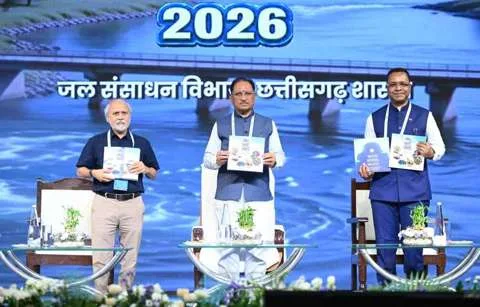
Rivers are not merely sources of water, but the life stream of our civilization, culture, agriculture, and prosperity. The state's life-giving rivers have played an important role in making Chhattisgarh the rice bowl. Protecting the rivers that have nourished our civilization and given us prosperity is our shared responsibility. Chief Minister Shri Vishnu Deo Sai said this while addressing the ‘Srot Mahotsav 2026’ and state-level workshop held at Omaya Garden in the capital Raipur today. Chief Minister Shri Sai inaugurated the workshop by lighting a lamp. The objective of the workshop is to identify and protect the origin sites and catchment areas of the rivers of the state, promote water conservation and ground water recharge, and give river conservation the form of a broad public campaign. In the workshop, subject experts associated with water conservation, river revival and water management along with members of state and district-level committees and representatives from various districts deliberated. Chief Minister Shri Vishnu Deo Sai said that if the river survives, water will survive and if water survives, life will survive. With this spirit, the state government is moving forward with a comprehensive action plan by prioritizing the protection of river origins and catchment areas through a combination of scientific approach, modern technology, traditional knowledge and public participation.
The Chief Minister said that the geographical, economic and cultural identity of Chhattisgarh is deeply connected with rivers. Many rivers of the state including Mahanadi have enriched agriculture, livelihood and social life. The existence of rivers depends on the health of their origin sites and catchment areas. Therefore, the work of river conservation cannot be limited only to its flow area. We have to make a comprehensive plan for conservation by understanding the entire ecosystem of the river from its source.
He said that to take forward the work of river conservation and revival effectively, committees have been formed at the state and district levels. Based on the guidance of subject experts and experiences from various fields in Srot Mahotsav, such a concrete action plan will be prepared which can be implemented on the ground in a time-bound manner.
River conservation campaign will move forward on five major pillars
Chief Minister Shri Sai said that work will be done on five major pillars for river conservation in the state, which are mapping, conservation, recharge, public participation and action plan. Every river and its catchment area will be mapped scientifically. Where is the origin of the river, what is the nature of its flow area, what kind of changes have taken place in land use and due to what reasons the natural flow of the river is being affected - all these aspects will be studied.
He said that based on scientific mapping and study, a plan for the conservation of the entire ecosystem of the river will be prepared. This will include works like forest and vegetation conservation, prevention of soil erosion, conservation and revival of traditional water structures, construction of new water harvesting structures as per requirement and ground water recharge.
The Chief Minister said that rainwater is the basic basis of our river system and groundwater. Therefore, instead of letting rainwater flow away rapidly, measures have to be taken to get it into the earth in maximum quantity. This will improve the groundwater level, revive water sources and help in maintaining water flow in rivers for a long time.
River conservation has to be made a mass movement
Chief Minister Shri Sai said that the goal of water conservation cannot be achieved only through government efforts. Active participation of society is most important for this. The villages situated on the banks of rivers and the people living there have a direct connection with the river, hence they have to be made the main participants in the river conservation process.
He told the members of district-level committees to form local committees in villages situated on the banks of rivers and take forward river conservation and revival works with the cooperation of panchayats. The local community should be informed about the condition of the river, its importance and measures for conservation. When society itself takes the responsibility of conserving its river and water sources, such efforts are more effective and sustainable.
The Chief Minister also urged experts to convey the scientific and technical knowledge related to water conservation to the people in simple and easy language. He said that technology is meaningful only when its benefit is visible on the ground and common citizens can understand and adopt it in their lives.
The Chief Minister said that human civilizations have developed on the banks of rivers. Rivers have provided water, food and livelihood to human life for generations. Therefore, as a civilized society, it is our responsibility to protect rivers and water sources for our coming generations. He expressed confidence that the conclusions drawn from Srot Mahotsav 2026 will prove important in preparing an effective roadmap in the direction of river conservation and water security in Chhattisgarh.
Two important MoUs for water conservation and modern technology
During the program, two important MoUs were signed with the objective of strengthening the institutional and technical capacity of the state in the field of water conservation.
Through the MoU signed with the National Water Academy, Pune, training and capacity building of officers and field staff associated with water conservation and water management will be promoted. This will help in delivering information on modern water management, new technologies and scientific methods to the ground level.
Similarly, through the MoU signed with Antrix Corporation, Bengaluru, ISRO's expertise and modern geospatial techniques will be utilized in the scientific analysis and monitoring of water resources. In the initial phase, the status of water resources will be studied, monitored and analyzed through advanced geospatial technology in an area of about 1540 square kilometers of Kunkuri tehsil.
Chief Minister Shri Sai said that by combining scientific data obtained from modern technology with local experience and traditional knowledge, more effective plans for water conservation can be made. This will also help in preparing solutions according to the needs of a particular region and monitoring their results.
Release of book ‘Neer-Nari-Nidhi’
Chief Minister Shri Vishnu Deo Sai released the book ‘Neer-Nari-Nidhi’ based on water conservation in the program. This book highlights the concept of protection of water (neer), participation of women (nari) and conservation of water wealth (nidhi). Various experiences, efforts and innovations related to water management and water conservation have been documented in the book.
Identification and conservation of water sources is necessary for future water security: Dr. Vinod Tare
Addressing the workshop, Desanga founder and IIT Kanpur Professor Dr. Vinod Tare said that to ensure water security, identification and conservation of river origins and water sources nourishing them is extremely necessary. Rainwater is the major basis of rivers and groundwater. The rapid flow of rainwater has to be controlled and maximum quantity has to be sent inside the ground, so that the groundwater level increases and water can be secured for the future.
Dr. Tare said that coordination between ancient knowledge, local and traditional experience and modern science and technology is necessary for water conservation. An action plan prepared by combining these three together can become the basis for long-term conservation of water sources and sustainable use of water.
Science-based and site-specific solutions will be prepared: Water Resources Department Secretary
Water Resources Department Secretary Shri Rajesh Sukumar Toppo said that the objective of Srot Mahotsav 2026 is to prepare a scientific, practical and time-bound action plan for the conservation of origin and catchment areas of the state's rivers. In river conservation, studying only downstream flow is not sufficient. For this, it is necessary to understand the entire ecosystem of the river together including source area, land use, soil moisture, groundwater recharge, vegetation and soil erosion.
He informed that nine river groups are being discussed separately in the workshop. Site-specific and science-based solutions will be prepared in these groups according to the conditions of a particular region. In this, emphasis will be laid on determining clear identification of the problem along with solutions, responsibility of implementation and time limit for assessment of results.
Shri Toppo said that water conservation is not just a subject of infrastructure construction. Participation of the local community is the key to long-term success and sustainability of conservation works. Based on the suggestions and conclusions received from the workshop, work will be moved forward in the direction of preparing a time-bound River Source Restoration Roadmap for Chhattisgarh.
Desanga founder and IIT Kanpur Professor Dr. Vinod Tare, subject experts associated with Namami Gange Mission, professors of NIT Raipur, members of state and district level committees, collectors and officers of various districts and experts working in the field of water and river conservation were present in the workshop.
त्रुटि दिखी? हमारी सुधार नीति और संपादकीय नीति देखें।