Chief Minister Mr. Vishnu Deo Sai gives clear mantras for development in a high-level review meeting of Chief Executive Officers of District Panchayats
Gram Panchayats must be developed not just as units for scheme implementation, but as centers for social change, economic prosperity, and self-reliant rural economy.
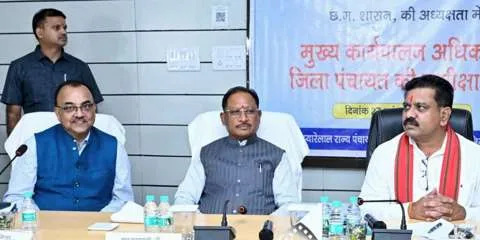
Gram Panchayats must be developed not just as units for scheme implementation, but as centers for social change, economic prosperity, and self-reliant rural economy. Only if Gram Panchayats are empowered, villages become self-reliant, and every villager participates in the development process, can the vision of a developed Chhattisgarh be realized. Chief Minister Mr. Vishnu Deo Sai said this while addressing a high-level review meeting and workshop of Chief Executive Officers (CEOs) of all District Panchayats of the state held at the SIRD campus in Nava Raipur, Nimora today. Chief Minister Mr. Sai said that the real meaning of good governance is that the benefits of government schemes should reach the last person without any discrimination. Gram Panchayats are the most effective platform to build self-reliant villages through public participation. Officers must win the trust of villagers while working with sensitivity, honesty, and a spirit of service. Chief Minister Mr. Sai told the officers that the true success of government schemes will be considered only when their benefits reach the last person and every citizen of the village becomes an active participant in the development journey. He directed to identify villages in every district where ideal development models can be developed through public participation, better use of local resources, and effective planning. The 'Viksit Bharat Ji Ram Ji Yojana' will give new momentum to rural development. Chief Minister Mr. Sai said that the 'Viksit Bharat Ji Ram Ji Yojana', implemented from July 1, is an important initiative to strengthen the rural economy. He directed the officers to prioritize job creation along with the construction of permanent assets and quality infrastructure through the scheme. This will give new momentum to water conservation, agriculture, rural infrastructure, livelihood, and the construction of community assets. The Chief Minister gave clear instructions that no compromise on the quality of construction work will be accepted at any level. Water conservation and better management of natural resources should be a priority. The Chief Minister said that rural development should not be limited to building construction only. Water conservation, soil health, agricultural productivity, animal husbandry, fisheries, and scientific use of local natural resources are the basis of sustainable development. He directed to prepare an action plan for water conservation according to local conditions in every district and prioritize rainwater harvesting and groundwater enrichment. More than 10.40 lakh women became 'Lakhpati Didis', now the goal is 'Crorepati Didis'. The Chief Minister said that under the leadership of Prime Minister Mr. Narendra Modi, women empowerment has got a new direction. In Chhattisgarh, more than 10 lakh 40 thousand women have become 'Lakhpati Didis'. Now the government is moving towards making a large number of 'Crorepati Didis' by connecting them with entrepreneurship, skill development, and self-employment. He instructed the CEOs of District Panchayats to identify eligible women and connect them with self-help groups, skill development, livelihood activities, and opportunities arising from the new industrial policy. Let the light of development reach the last village of Bastar. Directing the officers of Bastar division especially, the Chief Minister said that development works in remote and inaccessible areas should be done on top priority. He said that villages which were once difficult to reach are now getting basic facilities like roads, electricity, housing, ration, drinking water, education, and health rapidly. The government's goal is to bring the light of development to the last person. Emphasis on time-bound implementation of PM Awas and social security schemes. The Chief Minister directed to speed up construction work under the Pradhan Mantri Awas Yojana and provide benefits to all eligible beneficiaries on time. He said that there should not be any delay in the payment of all schemes, including social security pensions, and an effective monitoring system should be developed at the panchayat level. The Chief Minister said that the 'Pradhan Mantri Suryaghar Muft Bijli Yojana' is an important initiative in the direction of energy self-reliance. It should be promoted widely at the panchayat level to connect maximum families with solar energy. A special campaign should be launched to provide maximum benefits of solar pumps and other solar energy schemes to farmers and rural families. He said that the purpose of public life should not be just to discharge one's limited responsibility but to bring about such a positive change in society that future generations also remember it. Every officer should consider their responsibility as an opportunity for nation-building, taking inspiration from the ideal of national service presented by Prime Minister Mr. Narendra Modi. One person's resolve can change the picture of the whole society. Mentioning the Hiware Bazar model of Padma Shri Mr. Popatrao Pawar, Chief Minister Mr. Sai said that with strong will, honest leadership, and public participation, any village can be transformed. He said that a large number is not always needed to bring about change in society. If even one person takes a resolution and moves forward, the whole society stands with them. Recalling his first meeting in the year 1999, the Chief Minister said that when he became an MP for the first time, Mr. Popatrao Pawar was invited to guide the young MPs. At that time, the story he told as a young Sarpanch about the transformation of Hiware Bazar has become an ideal model of village development for the whole country today. The Chief Minister said that there is a need to take inspiration from the village development model developed by Nanaji Deshmukh at the Deendayal Research Institute in Chitrakoot and the social change brought about through education by Dr. Achyuta Samanta in Odisha. He told the officers that their own model of development should be prepared according to the local conditions, resources, and requirements of each district, so that sustainable and inclusive development can be ensured. The Hiware Bazar model showed the power of public participation. In the workshop, Padma Shri Mr. Popatrao Pawar shared the journey of the transformation of Hiware Bazar, explaining that in the year 1989, the village was struggling with a water crisis, migration, unemployment, and social problems. Through public participation, discipline, water conservation, and scientific management of natural resources, the village was comprehensively developed. Today, migration has ended in the village, there are no BPL families, about five thousand liters of milk is collected daily, and the per capita income has reached about nine lakh rupees. Deputy Chief Minister Mr. Vijay Sharma, Additional Chief Secretary Mrs. Richa Sharma, Secretary of Panchayat and Rural Development Department Mr. Bhim Singh, Director Mrs. Priyanka Rishi Mahobia, retired IAS officer Mr. Amarjit Sinha, CEOs of District Panchayats of all districts of the state, and senior officers of concerned departments were present in the meeting.
त्रुटि दिखी? हमारी सुधार नीति और संपादकीय नीति देखें।